
Understanding the UK Royal Line of Succession in 2026
The UK royal line of succession remains one of the most scrutinized constitutional structures in the modern world. Rooted in centuries of statutory evolution, common law precedent, and parliamentary sovereignty, the succession framework determines who inherits the throne of the United Kingdom and other Commonwealth realms. As of 2026, the line is governed primarily by the Act of Settlement 1701, the Bill of Rights 1689, and the more recent Succession to the Crown Act 2013, which introduced gender-neutral primogeniture for those born after October 28, 2011.
At the apex of the monarchy stands King Charles III, whose accession followed the reign of Queen Elizabeth II. The direct heirs include the Prince of Wales and his children, preserving continuity within the senior branch of the House of Windsor. However, the presence of secondary royals—particularly those who have faced public controversy—continues to generate constitutional and reputational discourse.
Among these figures, Prince Andrew, Duke of York, has drawn intense global scrutiny. His association with convicted financier Jeffrey Epstein has raised serious public relations and institutional credibility questions, especially concerning the symbolic integrity of the Crown.
Prince Andrew’s Position in the Line of Succession
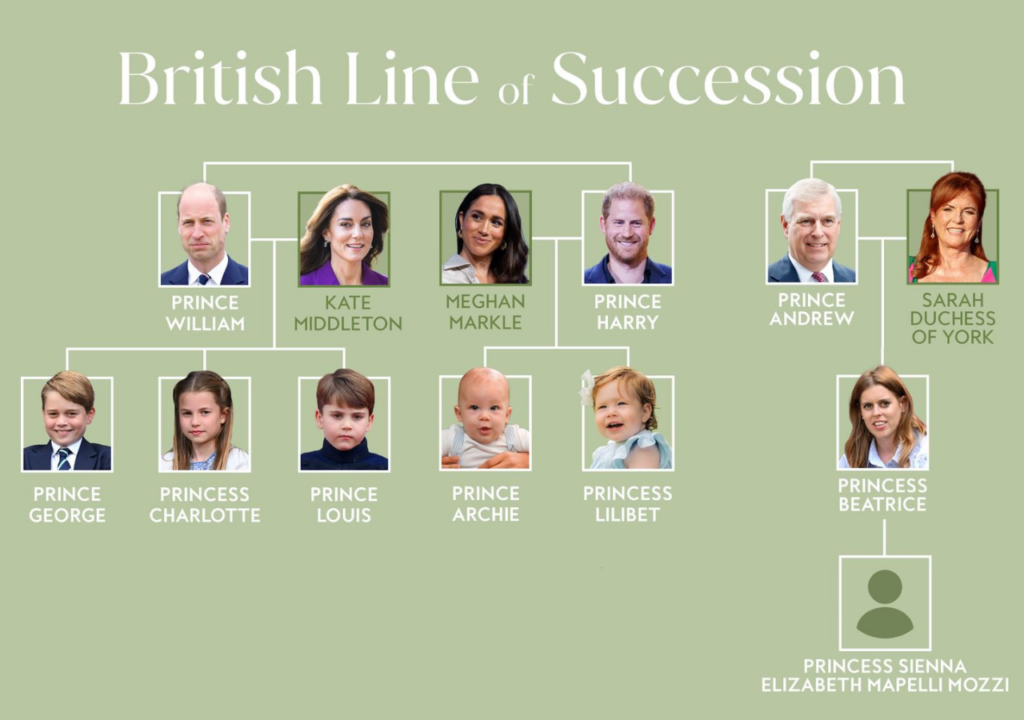
Despite stepping back from public duties in 2019 and relinquishing military affiliations and royal patronages in 2022, Prince Andrew remains within the legal line of succession. The succession is determined by bloodline and statute—not by public approval or ceremonial role.
Currently, Prince Andrew’s position falls significantly below the direct heirs of King Charles III. Ahead of him stand:
- The Prince of Wales
- The Prince of Wales’s children
- The Duke of Sussex and his children
As the monarchy transitioned into a streamlined operational model, Andrew’s functional removal from royal duties did not equate to formal exclusion from succession. Under UK constitutional law, removal from the line would require parliamentary legislation—an extraordinary and politically sensitive act.
This distinction is critical: constitutional eligibility differs from active royal function. The monarchy operates within a parliamentary democracy; therefore, symbolic considerations must be reconciled with legislative boundaries.
The Epstein Association and Its Impact on the British Royal Family

The relationship between Prince Andrew and Jeffrey Epstein generated global headlines following allegations connected to Epstein’s criminal activities. Although Prince Andrew has consistently denied wrongdoing and reached an out-of-court settlement in a civil case in the United States, the reputational impact has been profound.
For the British royal family, the issue transcends personal controversy. The monarchy’s legitimacy rests on public trust, institutional neutrality, and moral authority. Any association with criminality—even indirect—creates reputational risk that extends beyond individual members.
The Palace responded through:
- Formal withdrawal of public duties
- Removal of honorary military titles
- Suspension of patronage roles
- Reframing Andrew as a private citizen in official communications
This recalibration underscores a broader strategic approach: insulating the Crown from reputational contagion while preserving constitutional continuity.
Can a Royal Be Removed from the Line of Succession?
The UK constitution is uncodified but deeply structured. Altering the line of succession is neither simple nor symbolic. It requires:
- Parliamentary approval
- Coordination with Commonwealth realms recognizing the British monarch as head of state
- Royal assent
The precedent for succession reform was demonstrated in the 2013 legislation that ended male-preference primogeniture. However, that reform addressed systemic fairness—not individual conduct.
To remove Prince Andrew specifically would require legislation targeting an individual—an action with profound constitutional implications. Such a move could establish a precedent whereby moral or political judgment influences hereditary eligibility. This would represent a seismic shift in monarchical tradition.
Therefore, despite controversy, Andrew’s position remains legally intact unless Parliament chooses otherwise.
Public Perception and the Modernization of the Monarchy
The British monarchy has undergone extensive modernization over the past two decades. Under King Charles III, the emphasis has been on:
- Fiscal transparency
- Reduced working royal numbers
- Environmental advocacy
- Streamlined public engagements
Controversy surrounding Prince Andrew accelerated calls for a “slimmed-down monarchy.” By focusing official duties on senior working royals, the institution aims to preserve credibility.
Public opinion polling consistently demonstrates that trust in the monarchy correlates strongly with perceptions of ethical conduct. While Andrew’s legal status in succession persists, his practical absence from public life reflects an institutional firewall strategy.
The Strategic Role of King Charles III
King Charles III has approached succession management with constitutional prudence. His strategy appears to rest on three pillars:
- Non-interference with statutory succession
- Operational distancing from controversy
- Long-term institutional preservation
By refraining from seeking legislative removal of Prince Andrew, the Crown avoids politicizing the monarchy. Simultaneously, the withdrawal of duties sends a clear reputational signal.
This calibrated approach protects the integrity of the Crown while respecting constitutional boundaries.
International Implications Across the Commonwealth
Changes to the line of succession affect not only the United Kingdom but also Commonwealth realms such as Canada, Australia, and New Zealand. Any legislative adjustment would require parallel assent across these sovereign nations.
The 2013 reforms required coordinated legislative action among 16 realms. Replicating such coordination for an individual-based removal would involve diplomatic negotiation and political risk.
Therefore, the international dimension further complicates potential succession alterations.
Legal Precedents and Historical Context
Historically, succession crises in Britain have revolved around religion, legitimacy, and abdication. The abdication of Edward VIII in 1936 remains the most prominent modern example of a monarch stepping aside for personal reasons. However, that involved the sovereign himself—not a secondary royal.
No modern precedent exists for removing a non-heir royal from succession due to reputational damage alone.
This absence of precedent reinforces institutional caution.
The Future of the Line of Succession
Looking ahead, the prominence of Prince Andrew within succession discussions will diminish naturally over time. As younger generations ascend, his relative position continues to move downward.
The future focal point lies with:
- The Prince of Wales
- The next generation of heirs
- Long-term constitutional stability
In practical terms, the likelihood of Prince Andrew ever acceding to the throne is statistically negligible. Succession operates on probability as much as legality.
Media Coverage and Narrative Control
Global media scrutiny has intensified interest in royal governance structures. However, constitutional frameworks operate independently of media narratives.
The distinction between legal eligibility and institutional role is frequently misunderstood. The monarchy’s response strategy emphasizes clarity: Andrew holds no public office within the royal household, exercises no official duties, and receives no public-facing responsibilities.
This separation mitigates reputational spillover while maintaining constitutional continuity.
Stability Through Constitutional Discipline
The UK royal line of succession remains governed by statute, not sentiment. Prince Andrew’s association with Jeffrey Epstein has undeniably shaped public discourse and institutional recalibration. Nevertheless, constitutional mechanisms require legislative action for removal—an action that has not occurred.
King Charles III’s measured approach preserves institutional stability without triggering constitutional upheaval. The British monarchy, by design, evolves incrementally rather than reactively.
In 2026, the line of succession stands intact, structured by law, buffered by strategic distancing, and oriented toward long-term continuity. Public controversy may shape perception, but statute determines succession.
The resilience of the British Crown lies in this disciplined separation between reputation and constitutional structure.
